Puzzle mini-games & accessibility
I never post on LinkedIn, but somehow I have stumbled across a connection between #Queens (one of several mini-games hosted on LinkedIn that, for me, are starting to rival the NYT mini-games) and my professional field: teaching.
It came to me a few weeks ago as I scrolled through the beginning of my feed before actually doing any of the puzzles. Someone mentioned the “auto-X” feature on Queens. I knew some people might have a strong gut reaction and consider the feature cheating, but I decided to turn it on.
That day, I finished the puzzle in 1:26. Today, after using the feature for about a week, I finished Queens #587 in 8 seconds.
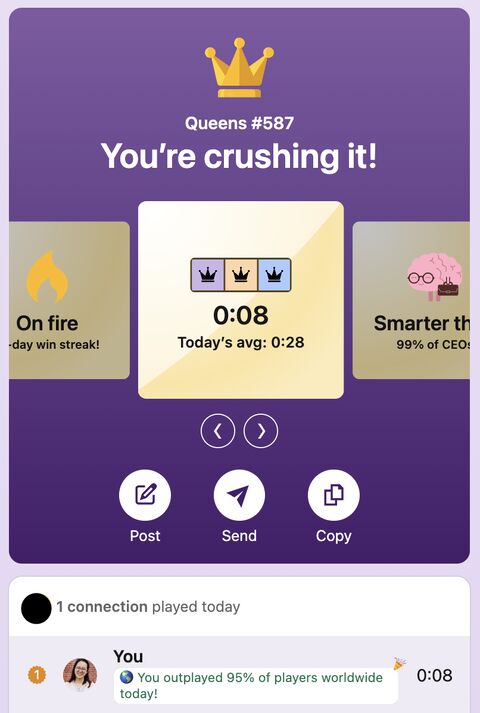
You outplayed 95% of players worldwide today!
Regardless of what the numbers are, since enabled the auto-X feature, my times have represented my thinking. When I first started playing, I didn’t know I could click and drag to X out multiple squares, so my times partially represented my thinking and partially represented the manual labor of clicked every X until a point came where I could just identify the Queens without any more elimination. When I learned through experimentation that I could click and drag, my times became a greater approximation of my actual logical thinking and less a representation of the time it took to X out squares.
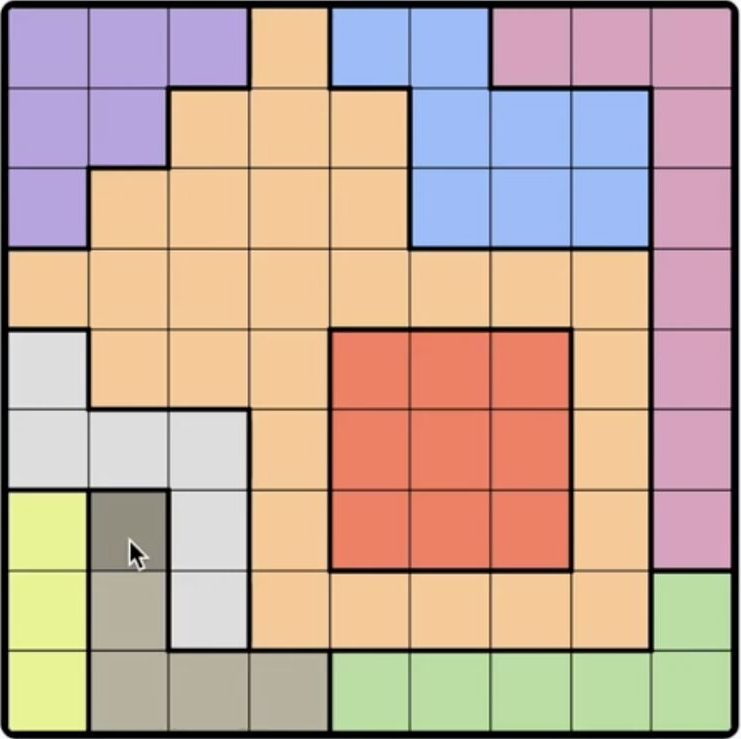
X-ing out squares in each row, column, and diagonally and orthogonally adjacent box is not a skilled deduction. It’s applying the instructions. What IS a skilled deduction is (spoiler for Queens #556) seeing that the yellow-green-ish region can only appear in column one, and thus the purple, orange and grey cells in column one is not viable options to have queens. X-ing on those cells with click and drag should be counted.
So now comes the connection to my professional field: teaching. It goes without saying that a player with the auto-X feature on has an advantage to a player without—that’s where the gut punch cheating instinct comes from. So you come to wonder about students and the hidden or not-so-hidden advantages they carry with them. How does a player come to learn about auto-X feature to begin with? How might an assessor be compromised if they are not aware of the existence of an auto-X feature? A player with a mouse will be faster than a student with a trackpad. Likewise, a player with normal range of motion in their dominant hand and fingers will have advantage of a player who doesn’t. A player who is colorblind is disadvantaged compared to a student who isn’t. The questions could go on.
Although my score today (Queens #587) says I outplayed 95% of people, the truth is that a huge majority of players are not playing with the same advantages that I have. In Queens, awareness can give us all the same advantages. In our classrooms (really, everywhere), let’s work to make reality as equitable.
The original post on LinkedIn can be found here.
GPT-5.6 Sol generated a new title for this post, which was originally a LinkedIn post with no title at all.


Leave a Reply